Make the reasoning behind an industrial decision visible.
This private prototype explores an industrial decision-support problem rather than equipment control. It helps an operator connect signals, possible causes, operating goals, constraints, procedures and consequences in a model another person can inspect. The agents organize the reasoning while the operating decision remains with an accountable human.
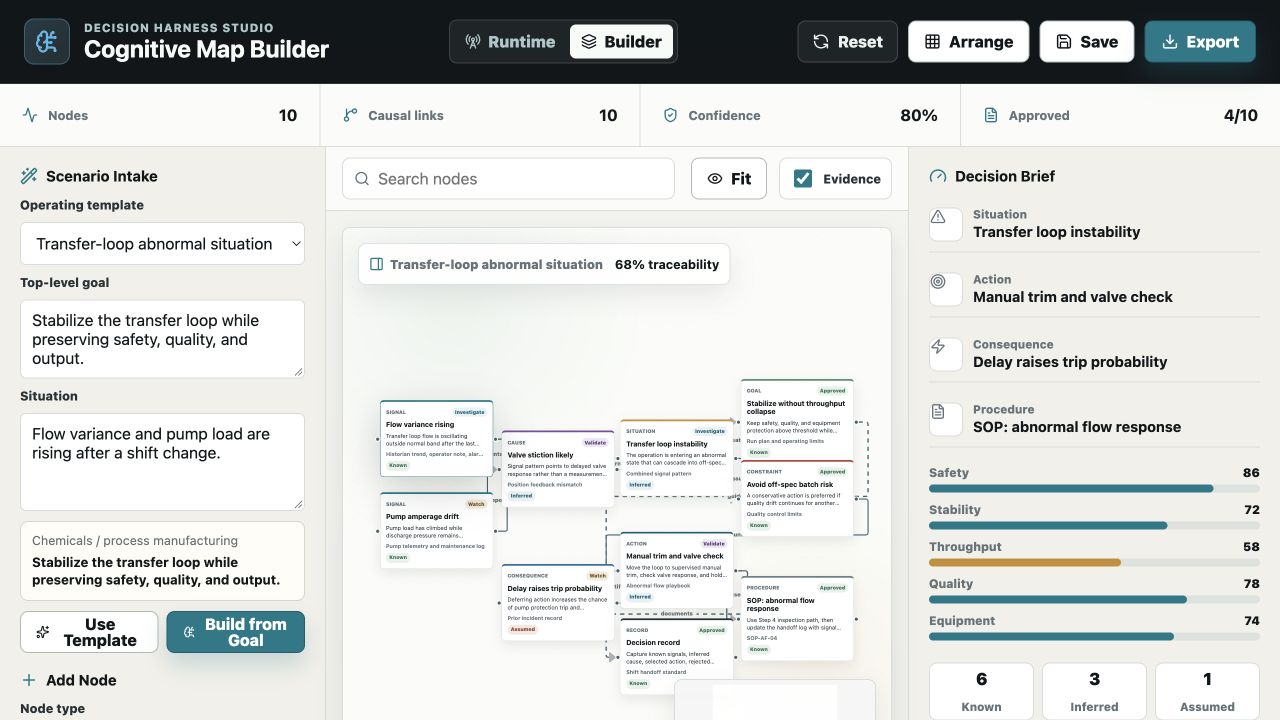
Actual prototype screen using a demonstration scenario. Client identifiers are not shown; no live equipment is connected.
The business problem
An operator needed to consider signals, possible causes and operating constraints together, then leave a decision record another shift could understand.
What changed in the workflow
A private prototype uses agents to organize a causal map, compare scenarios and preserve the reasoning for human review.
What this example demonstrates
A private decision-support prototype shown through actual application captures with demonstration data. It is not connected to equipment and is not evidence of a production deployment or a safety outcome.
Signals are only one part of an operating decision.
The workspace keeps evidence, uncertainty, goals and constraints visible so another person can inspect the reasoning.
An abnormal condition could have several plausible causes and incomplete evidence.
Operating goals and constraints mattered alongside the raw signals.
A recommendation needed to preserve uncertainty and procedure references.
The next shift needed a record of why an action was considered or rejected.
Turn a stated operating goal into a stable, inspectable decision structure.
Keep evidence, assumptions and confidence visible at the level of each node.
Compare possible actions and consequences without presenting software as the decision-maker.
Export a reviewable record that preserves human ownership of the final action.
Four bounded roles around one editable decision record.
A goal-to-map agent builds a stable decision structure, a scenario agent evaluates operating states and a record agent preserves the rationale. Every node remains inspectable and editable.
Goal-to-map agent
Creates a transparent causal map of signals, causes, goals, constraints, procedures and possible actions.
Evidence agent
Attaches available telemetry and references to the relevant parts of the map while preserving missing or conflicting evidence.
Scenario agent
Tests explicit operating scenarios and compares possible consequences against the stated constraints.
Decision-record agent
Captures the rationale, uncertainty, rejected options and accountable owner without controlling equipment.
A traceable record from condition to accountable action.
A portable browser prototype with no equipment command path.
React 19 and TypeScript in a browser-based decision workspace.
React Flow for inspectable causal nodes, connections and editable decision structure.
Motion and Lucide for focused transitions, state changes and familiar controls.
Local browser storage with JSON export for a portable prototype record.
The prototype has no server database; records stay in the browser unless the user exports them.
A static browser application deployed as a private prototype, with no equipment-facing service.
No equipment connection, command path or autonomous operating action.
Evidence for how the team reasons, not a claimed operating outcome.
Time required to bring signals, constraints and procedure references into one review.
Important operating limits identified before a recommendation is finalized.
Plausible actions and consequences reviewed by the operator.
Recommendations that preserve their evidence, uncertainty and accountable owner.
Start with the work, the constraint and the decision owner.
You do not need a project that matches this example. Bring the problem you want to solve, and we will assess the fit, compare possible approaches and agree on a useful first scope.
Discuss the problem